
Between 30% and 69% of AI-generated references in biomedical writing are fabricated — not slightly wrong, but completely invented. If you have ever used ChatGPT, Claude, Gemini, or any other large language model to help with a literature review, there is a statistically meaningful chance your bibliography already contains citations that do not exist. This guide explains exactly why AI hallucinations in citations happen, what the research says about which models are worst, and the practical verification workflow that brings your hallucination risk close to zero.
Why AI Models Fabricate Citations
Large language models do not search databases. They predict text. When you ask an AI to find a source supporting a claim, it generates what a plausible-looking citation would contain — author names, a journal title, a year, a volume number — based on statistical patterns learned from billions of documents. It is not retrieving; it is composing. The result can look completely legitimate while corresponding to nothing that exists.
A 2025 arXiv audit of fabricated citations at NeurIPS found that 76% of total fabrications used domain-appropriate terminology and plausible-sounding titles specifically designed — not intentionally, but statistically — to pass superficial verification. The model learned that citations in this field look a certain way, and it reproduced that pattern faithfully, without any underlying source.
The problem is worse for niche topics, recent publications, and book chapters — areas where training data is sparse and the model has fewer real examples to draw from. The less data a model has seen on a topic, the more it relies on pattern-generation rather than recall, and the higher the fabrication rate climbs.
How Bad Is It by Model?
Not all AI tools carry the same citation risk. A multi-model bibliographic retrieval study found fabrication rates ranging from under 20% to over 55% for journal article citations — the category most relevant to academic research. GPT-3.5 performed worst. GPT-4o and Claude performed better but were far from safe. No model scored zero.
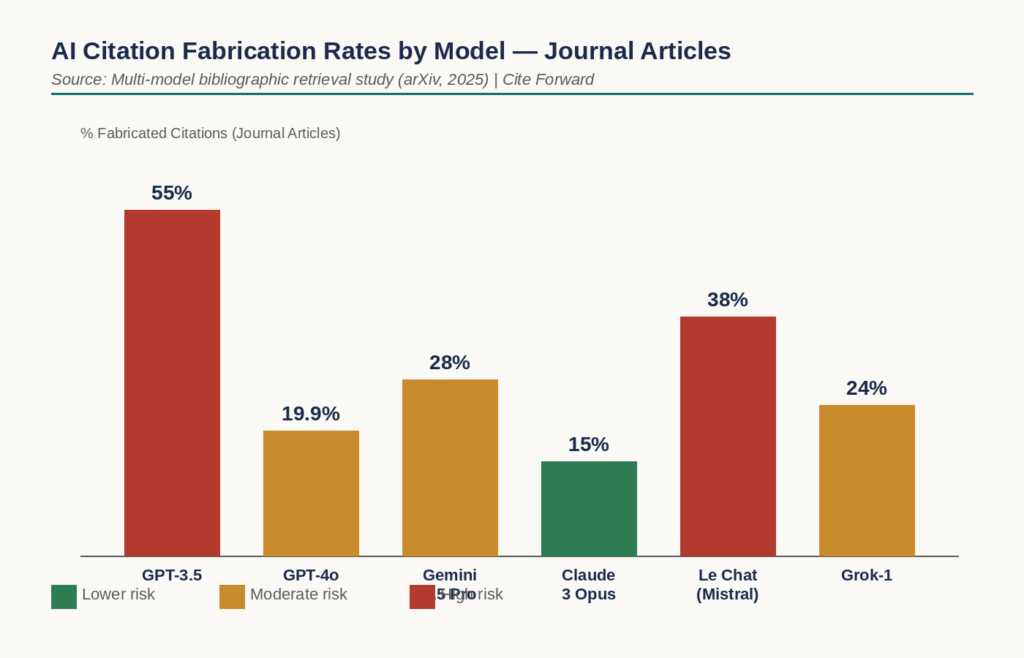
Two practical conclusions from this data: first, switching to a better model reduces risk but does not eliminate it. Second, the citation type matters — journal articles are fabricated far more often than books (78% vs 12.9% in the same study). If your bibliography is heavy on journal articles, your risk profile is higher regardless of which model you use.
The Scale of the Problem in Published Research
AI citation hallucinations are not just a personal writing risk — they are now a documented, large-scale problem in the published scientific record. The most comprehensive audit to date, led by Columbia University’s Maxim Topaz and published in The Lancet in 2026, scanned 2.5 million biomedical papers and 97 million citations using an automated verification system.
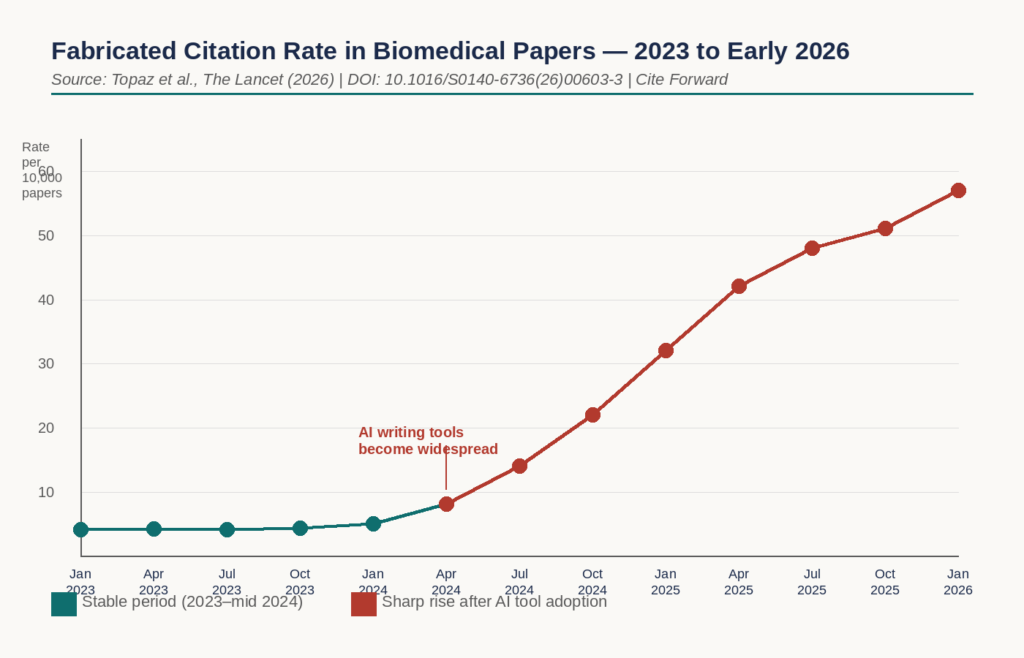
The fabrication rate was stable throughout 2023 at around four per 10,000 papers. Beginning in mid-2024 — which coincides with the mainstream adoption of AI writing tools — the rate rose sharply, reaching 57 per 10,000 papers by early 2026. That represents a 12-fold increase in under three years.
Separately, arXiv announced stricter enforcement in 2026 holding authors responsible for unchecked AI output including hallucinated references. And a public database maintained by legal researcher Damien Charlpotin now documents more than 1,500 legal decisions in which generative AI produced fabricated citations — the same failure mode, outside academia entirely.
The Four Types of AI Citation Hallucination
Not all hallucinated citations are the same. Understanding the type helps you choose the right verification method:
Total fabrication: The entire citation is invented — title, authors, journal, year, DOI. This is the
most common type (66% of fabrications at NeurIPS 2025) and the easiest to catch with a simple database lookup.
Semantic hallucination: A real citation that uses plausible-sounding but incorrect details. The journal exists, the author exists, but this specific paper doesn’t. Harder to catch without checking the DOI directly.
Wrong-paper citation: A real paper exists, but it doesn’t support the claim being made. A 2026
biomedical audit found 15.9% of seemingly real citations were wrong-paper citations — the most dangerous type because a DOI check passes.
Metadata corruption: A real paper with corrupted details — wrong year, wrong volume, wrong author order. Often catches itself during formatting, but can slip through. The implication: a DOI check is necessary but not sufficient. Verifying that a DOI resolves catches
total fabrications and metadata corruption. It does not catch wrong-paper citations, which require you to actually confirm the source supports the specific claim.
What Actually Reduces Hallucination Risk
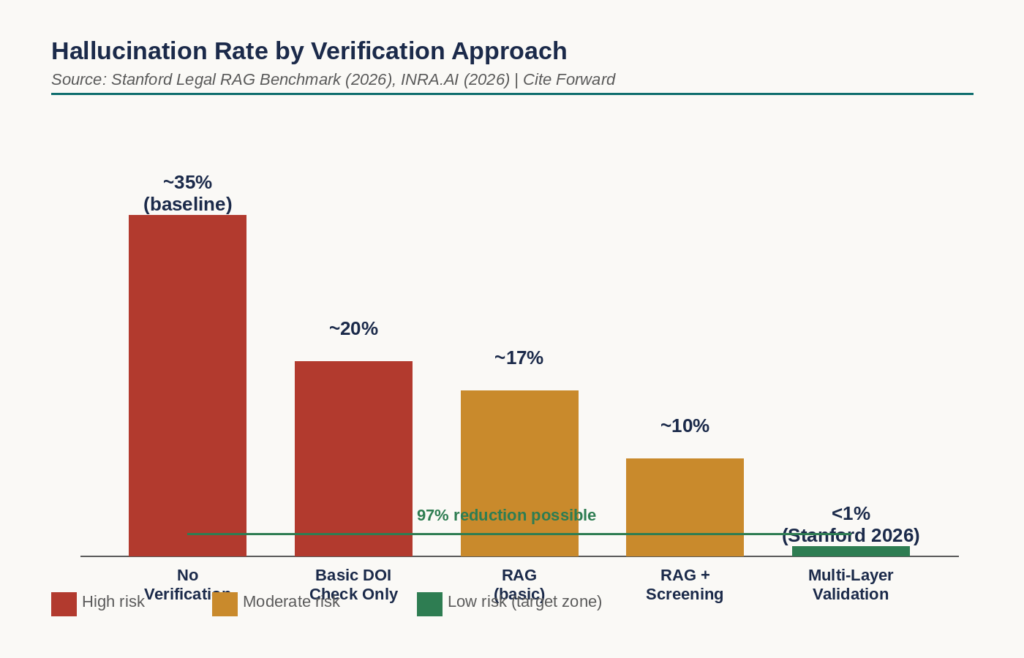
The good news: multi-layer verification approaches bring hallucination rates close to zero. Stanford’s 2026 Legal RAG benchmark found that combining retrieval-augmented generation with rigorous screening reduced hallucination rates by 71%, and multi-layer validation approaches achieved under 1% hallucination rates across all citation types.
The 5-Step Verification Workflow
Here is the practical workflow that gets you to under 1% hallucination risk. Each step takes less than two minutes per citation:
Step 1 — Never copy-paste AI citations directly
Treat every AI-suggested reference as a lead, not a source. Write it down separately and verify
before it touches your bibliography. This single habit eliminates the most common error.
Step 2 — Resolve the DOI in Crossref
Go to doi.org and paste the DOI. If it doesn’t resolve to a real paper, it’s a total fabrication. Crossref is free and takes under 10 seconds per citation. This catches ~66% of hallucinations immediately.
Step 3 — Search the exact title in PubMed or Scopus
Search the full title in quotes in PubMed (biomedical), Scopus, or Google Scholar. Confirm the authors, journal, year, and volume all match exactly. A mismatch on any field signals a semantic hallucination.
Step 4 — Confirm the source supports your claim
Read at minimum the abstract. Does the paper actually support the specific claim you’re citing it for? Wrong-paper citations — where a real paper exists but doesn’t support your claim — are invisible to DOI checks and require this step.
Step 5 — Use Scite for contested claims
For any citation supporting a critical claim, run it through Scite (scite.ai). Scite shows whether the paper has been cited supportively, contradictingly, or merely mentioned by later work. A paper cited mainly as a contradiction is a weak citation regardless of whether it exists.
Tools That Help (and Their Limits)
| Tools | Best For | Limitation |
| scale.ai | Citation context verification | Shows whether a paper is cited supportively |
| Crossref (doi.org) | DOI resolution | Free, instant, catches total fabrications |
| Elicit | Retrieval-augmented literature search | Reduces hallucination risk at the discovery stage |
| AiCitationChecker | Automated citation verification tool | Useful for large bibliographies |
The Bigger Picture
AI hallucinations in bibliographies are not a minor formatting issue. A fabricated citation that makes it into a published paper becomes part of the citation record that other researchers build on. The Lancet audit found 98.4% of papers with fabricated references had not been retracted at the time of the study — meaning the error propagates uncorrected.
The practical answer is not to stop using AI for research. It is to use AI for what it does well
exploration, synthesis, drafting — and to apply systematic human verification at the specific point where AI is weakest: citation accuracy. The 5-step workflow above takes roughly 2 minutes per citation. For a 40-source bibliography, that is about 80 minutes. Against the cost of a retraction or a failed defence, it is not close.
Sources & Further Reading
- Topaz et al — Fabricated citations: an audit across 2.5 million biomedical papers — The Lancet
- arXiv — Compound Deception in Elite Peer Review: 100 Fabricated Citations at NeurIPS 2025.
- Walters & Wilder — Fabrication and errors in the bibliographic citations generated by ChatGPT — Scientific Reports (2023).
- Stanford Legal RAG Benchmark — Multi-layer citation validation reduces hallucinations — Stanford Law (2026)
- Mentionova — 25 LLM Citation Statistics 2026 — mentionova.com
- Enago Academy — AI Hallucinations in Research: Why 40% of AI Citations Are Wrong — enago.com
- Citely — The Crisis of AI Hallucinations in Research — citely.ai
- INRA.AI — AI Citation Hallucinations: Verify Fake References (2026) — inra.ai
- Cite Forward — Fabricated Citations Are Surging in Published Research — citeforward.com — Related reading.